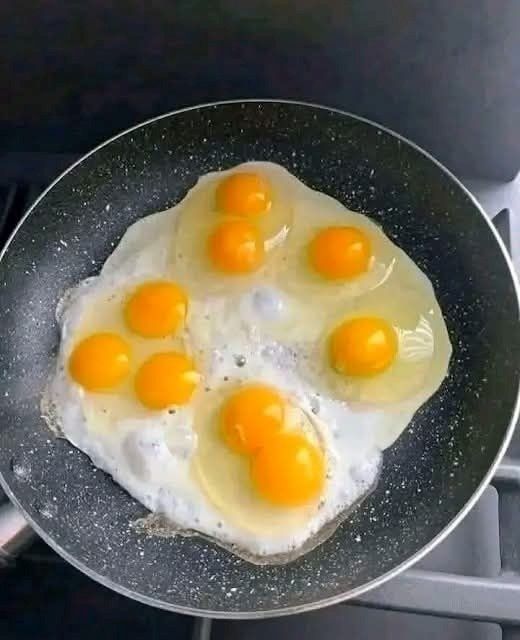
The Curious Question That Turns Cooking Into a Kitchen Mystery**
There’s a moment every home cook knows well. You crack one egg into a pan. Then another. Then another. Suddenly, you pause, spatula hovering mid-air, staring down at the skillet with genuine confusion.
How many eggs are actually in there?
It’s such a simple question, and yet it feels surprisingly hard to answer. The eggs spread, merge, puff, and transform. What started as neat little orbs becomes a shifting landscape of whites and yolks, bubbles and edges, gloss and steam. And before you know it, counting becomes less about numbers and more about perception.
“How many eggs are in the pan?” might sound like a joke, a meme, or a throwaway thought — but it’s also a fascinating intersection of cooking, psychology, physics, and habit. This question reveals how we cook, how we see food, and how easily our brains get fooled once ingredients start to change.
So let’s crack into it (yes, that pun was inevitable).
The Universal Egg Moment
Eggs are one of the most cooked foods in the world. Breakfasts, lunches, dinners, baking projects, sauces — eggs show up everywhere. And because they’re so familiar, we often cook them on autopilot.
But eggs have a unique quality:
they stop looking like individual objects almost immediately.
The moment egg whites hit heat, they spread. Yolks break. Edges blur. What was once countable becomes abstract.
That’s when the question sneaks in:
Wait… did I add three eggs or four?
Why Eggs Are So Hard to Count Once They’re Cooking
At first glance, this seems silly. Eggs are discrete units. You crack them one by one. Counting should be easy.
But several things happen that confuse our brains.
1. Eggs Lose Their Boundaries
Before cooking, an egg is clearly defined by its shell. Once cracked, that boundary disappears.
- Whites spread thin and wide
- Yolks flatten or break
- Multiple eggs merge into one mass
The brain relies on edges and separation to count objects. When those disappear, so does our certainty.
2. Volume Is Deceptive
Three eggs can look like a lot. Five eggs can look like not much at all, depending on:
- Pan size
- Heat level
- Whether yolks are intact
- How much the whites spread
A wide skillet can make six eggs look sparse. A small pan can make three eggs look overwhelming.
3. Eggs Change as They Cook
Eggs are shape-shifters.
- Raw eggs spread
- Cooking eggs contract
- Scrambled eggs puff
- Fried eggs set and lift
Your brain is trying to count something that won’t stay still.
Pan Size: The Silent Egg Multiplier
One of the biggest reasons we misjudge egg quantity is the pan itself.
Small Pan Illusion
- Eggs pile up
- Whites overlap
- Everything looks dense
You might think:
“Wow, I used a ton of eggs.”
In reality, it might only be two or three.
Large Pan Illusion
- Eggs spread thin
- Space between yolks
- More pan visible
You might think:
“Did I even add enough eggs?”
But there could be six or more quietly covering the surface.
The Psychology of Counting Food
Humans are notoriously bad at estimating quantities — especially once things change form.
We’re good at counting:
- Apples
- Cookies
- Eggs in a carton
We’re bad at counting:
- Liquids
- Melted butter
- Scrambled eggs
- Sauces
Once food becomes fluid or amorphous, the brain switches from counting to guessing.
Scrambled Eggs: The Ultimate Counting Disruption
Scrambled eggs are the biggest culprit.
You start with:
- Clear whites
- Bright yolks
- Visible separation
Then you whisk.
Suddenly:
- Everything is yellow
- Texture is uniform
- No visual clues remain
At that point, the only way to know how many eggs are in the pan is to remember — and memory is unreliable, especially when cooking is happening alongside coffee, conversation, or a hungry family.
Why This Question Became Internet Gold
“How many eggs are in the pan?!” has popped up repeatedly online because it hits a universal nerve.
It’s funny because:
- Everyone has been there
- The answer always feels obvious… until it isn’t
- The visual doesn’t match expectation
It’s the same reason people argue about:
- How many pancakes are too many
- Whether that’s “enough pasta”
- Why rice multiplies mysteriously
Eggs just happen to be the most relatable example.
Egg Density: Not All Eggs Are Equal
Even if you count perfectly, eggs themselves vary.
Egg Size Matters
- Small
- Medium
- Large
- Extra-large
Most recipes assume large eggs, but real-world cooking often doesn’t.
Five small eggs ≠ five extra-large eggs
Yet visually, once cooked, they may look similar.
Freshness Changes Behavior
- Fresher eggs have firmer whites
- Older eggs spread more
Two pans with the same number of eggs can look completely different depending on freshness.
Cultural Expectations: How Many Eggs Is “Normal”?
Perception also depends on where and how you grew up.
- Some cultures use one egg per person
- Others consider two eggs generous
- Some dishes call for six or more without hesitation
So when you look at a pan of eggs, your brain compares it to an internal standard that may not be universal.
That’s why one person says:
“That’s a ton of eggs.”
And another says:
“That barely looks like enough.”
Breakfast Math: Eggs vs People
One of the most common kitchen miscalculations happens at breakfast.
You ask:
- How many people are eating?
- How hungry are they?
- Are there sides?
Then you crack eggs… and second-guess yourself halfway through.
Too few eggs feels stingy.
Too many eggs feels wasteful.
And once they’re in the pan, there’s no undo button.
Eggs Expand… Sort Of
While eggs don’t literally expand like popcorn, they change texture and volume when cooked.
- Air gets incorporated when whisked
- Proteins firm up and trap steam
- Scrambled eggs fluff when cooked gently
This can make it look like you used more eggs than you did — or fewer, depending on technique.
How Restaurants Always Know the Answer
Ever notice that restaurant eggs always seem perfectly portioned?
That’s not magic. It’s repetition.
Restaurants:
- Use standardized ladles or cartons
- Portion scrambled eggs by weight or volume
- Cook the same dish dozens of times a day
Home cooks rely on intuition — which is great, until intuition gets distracted.
The Egg Carton Memory Test
There’s a simple reason many people lose track of how many eggs they’ve cracked:
We don’t look back at the carton.
Once an egg hits the pan, our brain moves on. We assume we’ll remember. But cooking involves multitasking, and memory is fragile.
By the time the pan is sizzling, the number is already fuzzy.
Why This Question Is Actually About Cooking Confidence
“How many eggs are in the pan?” isn’t really about eggs.
It’s about:
- Trusting your instincts
- Letting go of perfection
- Accepting that cooking is fluid
Great cooking doesn’t require perfect counting. It requires adjustment.
Too many eggs? Add more seasoning.
Too few eggs? Add toast, potatoes, or fruit.
The pan doesn’t need precision — it needs intention.
Egg Ratios: When Counting Actually Matters
Of course, there are times when the number matters.
When Counting Eggs Is Crucial
- Baking
- Custards
- Sauces like hollandaise
- Quiches and frittatas
In those cases, eggs are structural. But for everyday cooking — scrambles, fried eggs, omelets — flexibility rules.
The Visual Illusion of Yolk Placement
Yolks play tricks on us too.
- Intact yolks make it easier to count
- Broken yolks disappear into the whites
- Over-easy eggs hide their yolks under whites
A pan with four intact yolks looks more crowded than a pan with six scrambled eggs.
Social Media and the Egg Guessing Game
Short videos and photos exaggerate this illusion.
Camera angles:
- Flatten depth
- Hide edges
- Emphasize texture
A photo of eggs in a pan invites guessing — and arguments.
That’s part of the fun.
Why We Love These Tiny Kitchen Mysteries
Questions like this stick because they’re:
- Harmless
- Relatable
- Slightly absurd
- Comfortingly mundane
In a world full of heavy topics, wondering how many eggs are in a pan feels refreshingly low-stakes.
How to Always Know (If You Want To)
If you truly want certainty:
- Count shells, not eggs
- Line cracked shells up on the counter
- Crack eggs into a bowl first
- Use the carton as a reference
But honestly? You don’t have to.
When the Answer Doesn’t Matter at All
Some of the best meals come from not knowing exactly how many eggs were used.
What matters more is:
- Texture
- Seasoning
- Heat control
- Timing
Eggs forgive imprecision. They reward attention.
The Beauty of the Question
“How many eggs are in the pan?” works because it’s simple, funny, and revealing.
It reminds us that:
- Cooking is sensory, not mathematical
- Our eyes can be fooled
- Perfection isn’t required
It’s a question that invites laughter, not stress.
Final Thoughts: The Pan Knows, Even If You Don’t
At the end of the day, the pan doesn’t care how many eggs are in it. It responds to heat, fat, movement, and time.
Whether it’s:
- Two eggs or six
- Scrambled or fried
- Breakfast for one or brunch for many
The result can still be delicious.
So the next time you find yourself staring into a sizzling skillet, genuinely unsure how many eggs you added — smile. You’re cooking like a human, not a calculator.
And honestly?
That’s how the best food gets made
