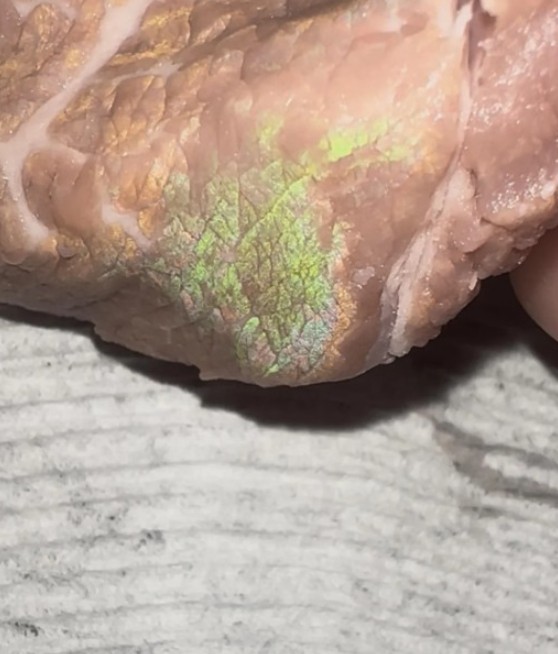
You’re making a sandwich, pull out a slice of roast beef or deli turkey—and suddenly, you see it: a shimmering rainbow sheen, like oil on water, dancing across the surface. For a split second, you wonder: Is this safe? Did my meat turn into a disco ball?
Good news: that iridescent glow is completely normal—and harmless. It’s not mold, spoilage, or food coloring. It’s pure physics meeting biology. Let’s break down why your meat sometimes looks like it’s been kissed by a prism.
The Cause: Light + Muscle Structure = Rainbow Effect
Meat is made of tightly packed muscle fibers, arranged in parallel bundles—like strands of rope or guitar strings (as you so perfectly put it!).
When light hits these fibers at just the right angle, it diffracts—bending and scattering into its component colors (like a rainbow). This is the same science behind:
Oil slicks on wet pavement
Soap bubbles
Peacock feathers
It’s called structural coloration—color created by microscopic structure, not pigment.
🌈 Key fact: This effect is most common in cooked or processed meats like roast beef, pastrami, or deli turkey—because cooking tightens and aligns the fibers, enhancing the diffraction.
Why Some Meats Show It More Than Others:
Why Some Meats Show It More Than Others
Meat Type
Likely to Show Rainbow?
Why
Roast beef
✅ Very common
Tight, uniform fiber structure after roasting
Deli turkey or ham
✅ Common
Sliced thin, fibers aligned during processing
Raw steak
❌ Rare
Continued on the next page
Fibers are less organized; surface is matte
Ground meat
❌ Never
Fibers are broken up—no uniform surface
💡 Pro Tip: The effect is strongest when meat is cold, moist, and sliced against the grain—conditions that maximize light reflection.
How to Tell If It’s Safe (Spoiler: It Almost Always Is)
That rainbow sheen is not a sign of spoilage—but you should still check for actual red flags:
✅ Normal rainbow sheen:
Only appears at certain angles
Disappears when you tilt the meat
No off smell, slimy texture, or discoloration
❌ Signs of spoilage (throw it out!):
Sour, ammonia-like, or rotten smell
Slimy or sticky surface
Grayish-green or dull brown color (not just iridescence)
Mold spots (fuzzy white, green, or black patches)
🥩 Rule of thumb: If it smells and feels fresh, the rainbow is just a trick of the light—not a warning.
Fun Fact: Even Raw Meat Can Do This (Rarely!)
While uncommon, raw meat can occasionally show iridescence if:
It has a very smooth surface (like a whole muscle cut)
It’s exposed to bright, direct light
There’s a thin layer of moisture acting like a lens
But again—it’s optical, not biological.
The Bottom Line: Enjoy Your Meat with Confidence
That rainbow shimmer isn’t a defect—it’s a testament to the intricate structure of muscle tissue. It means your meat is intact, well-processed, and likely high quality.
So go ahead—pile that roast beef on your sandwich, admire the colors, and savor every bite. Your eyes aren’t deceiving you… they’re just witnessing the quiet beauty of food science.
Have you seen rainbow meat? Did it freak you out at first? Share your story below—we’ve all been there! 🌈🥩✨
